Here's what most people get wrong: they treat meditation like strength training, assuming more reps equal bigger gains.
I've watched friends download Headspace, commit to meditating three times daily, burn out within a week, then abandon the practice entirely. Meanwhile, my colleague who sits for just eight minutes every morning—same time, same corner of her bedroom—has maintained her streak for two years. Guess whose anxiety levels dropped?
Scientists studying contemplative practices have discovered something counterintuitive. According to research from neuroscience labs studying long-term meditators, someone practicing ten minutes daily for four weeks will usually demonstrate stronger improvements in sustained attention than someone cramming three 45-minute sessions into their weekends. Same total minutes per week. Completely different outcomes.
Your brain doesn't store meditation like a battery. It responds to patterns. Regular exposure—even brief—reinforces the neural circuits governing attention and emotional awareness. String together too many gaps between sessions, and those circuits lose their strength. Pack too many sessions into a single day, and you'll hit a point where additional sitting produces minimal extra benefit.
The habit formation piece matters as much as the neurological one. When you meditate daily, your brain starts anticipating the practice. It becomes automatic, like making coffee. Sporadic longer sessions never achieve this automaticity—each time feels like starting from scratch.
That said, I can't hand you a universal prescription. Your ideal frequency depends on whether you're managing panic attacks or cultivating insight, whether you have three kids under five or live alone, whether your nervous system runs hot or you tend toward dissociation.
Recommended Meditation Frequency for Beginners vs. Experienced Practitioners
Author: Lena Ashcroft;
Source: 5sensesspa.com
If you're new to this: One session per day. That's it.
People starting out consistently underestimate how challenging it is to sit still with an unoccupied mind. I've seen beginners set timers for twenty minutes, then spend the entire session watching the clock and wondering why their thoughts won't stop. Five minutes can feel endless when you're wrestling with mental resistance for the first time.
Your first thirty days should prioritize showing up over going deep. Pick one slot—right after you brush your teeth, during lunch, before dinner. Whatever. Just make it the same slot. Attach meditation to something you already do without thinking about it.
The mistake I see repeatedly: "I'll meditate whenever I find time." This translates to never. Your calendar will eat that intention alive. Block the time like you'd block a doctor's appointment.
If you've been practicing for months: You're probably ready for either a second session or a longer single sit.
Once meditation becomes reflexive—you do it without negotiating with yourself—you might notice one session feels incomplete. Not because you're failing, but because your capacity has expanded. This is when many practitioners naturally drift toward adding a second session.
People who've stuck with daily practice for six months or more often land on 20-40 minutes once or twice daily. Traditional programs like MBSR (Mindfulness-Based Stress Reduction) structure their entire curriculum around this duration. Transcendental Meditation explicitly teaches twice-daily practice.
Don't leap from one to two sessions overnight. Add a five-minute sit at the opposite end of your day from your main practice. If that feels effortless after three weeks, extend the second session gradually.
Some advanced practitioners sit for an hour or longer, but I've met monks who generate more depth in fifteen focused minutes than distracted students achieve in ninety. Duration impresses nobody. Presence does.
Author: Lena Ashcroft;
Source: 5sensesspa.com
Once Daily vs. Twice Daily Meditation: What the Research Shows
A study published in Mindfulness journal during 2023 tracked two groups over eight weeks. Group A meditated once daily for twenty minutes. Group B split those same twenty minutes into two ten-minute sessions. Both groups showed comparable stress reduction and emotional regulation improvements, but Group B reported something interesting: the practice felt easier to maintain, and they were less likely to skip days.
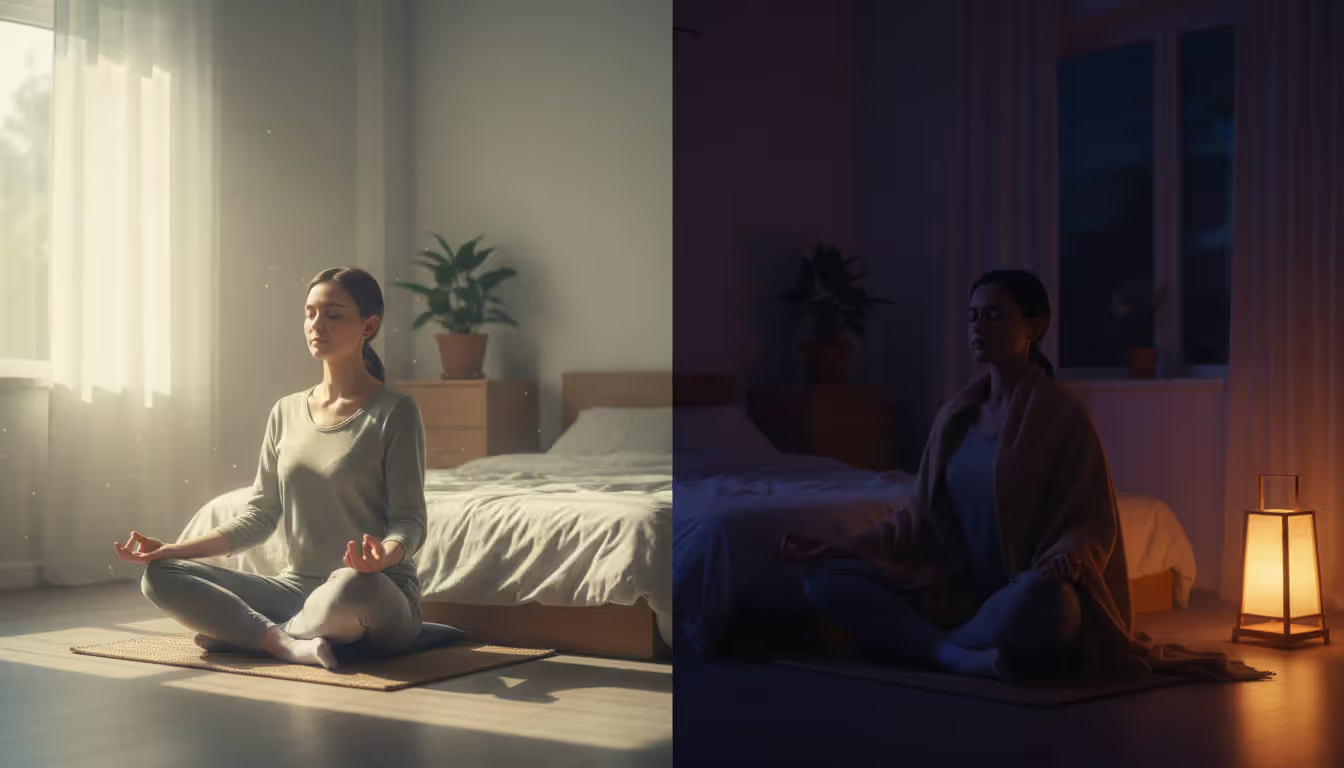
Twice daily offers some distinct advantages. Your morning session establishes your mental baseline before emails and meetings destabilize it. Your evening session helps metabolize accumulated tension before it calculates into chronic stress. You're also creating two daily check-ins with your internal state, which accelerates pattern recognition.
But I'm not here to sell you on twice daily as inherently superior. Longer single sessions let you push through the surface-level mental chatter into quieter territory. Many experienced meditators describe the first ten minutes as purely settling time—the actual meditation starts afterward. Split your practice into two brief sessions, and you might spend all your time in the settling phase.
Practical reality usually matters more than theoretical ideals. If you're parenting young children, working irregular hours, or barely maintaining one session, forcing a second creates more stress than it dissolves. One focused session beats two resentful ones every time.
Some people have more cognitive energy at specific times. Morning people find evening meditation nearly impossible—they're too exhausted to sustain attention. Night owls can't focus at 6 AM; they're essentially meditating while still half-asleep. Forcing practice when your brain won't cooperate turns meditation into another item on your list of daily failures.
What the research actually shows: establishing a daily rhythm matters more than whether that rhythm includes one session or two. Start with what you'll actually maintain, then modify based on results rather than ideology.
Ideal Session Length Based on Your Schedule and Goals
Five minutes: Legitimately useful, not a cop-out.
Brief sessions work perfectly for maintenance on chaotic days, for beginners establishing consistency, or as a second practice if you've already completed a longer sit. Five minutes of focused breathing can reset your nervous system between back-to-back meetings or before walking into a difficult conversation.
Don't write off short sessions as inadequate. Researchers at UMass Medical School found that participants practicing just five minutes daily showed measurable attention improvements after fourteen days.
Ten minutes: The sweet spot for most people building a new habit.
This duration gives you enough time to settle past initial restlessness while staying short enough to fit into almost any schedule. Ten minutes lets you move through the "what am I doing, this is boring, I should check my email" phase into a few moments of actual presence.
Twenty minutes: The standard duration cited in most research studies.
Many meditation teachers and clinical protocols use twenty minutes as their baseline "regular practice" recommendation. This length provides sufficient time to settle, work with whatever mental or emotional content arises, and stabilize before your timer sounds.
Twenty minutes twice daily structures both Transcendental Meditation and most MBSR programs. The evidence supporting benefits at this duration is substantial.
Thirty-plus minutes: For specific goals or experienced practitioners.
Longer sessions make sense when you're working with a teacher on particular techniques, preparing for a meditation retreat, or cultivating deep concentration states. Beyond thirty minutes, attention quality matters more than clock time.
Matching duration to specific outcomes:
Managing stress and anxiety: 10-20 minutes once or twice daily
Sharpening focus for work: 10-15 minutes before starting your day
Processing emotions or supporting therapy: 20-30 minutes daily
Developing deep concentration: 30-45 minutes daily
Spiritual or insight practices: varies by tradition, often 45-60+ minutes
Your real-world constraints aren't optional. A parent whose toddlers wake at 6 AM might only have five minutes before chaos erupts. That's completely fine. Consistent five-minute sessions beat sporadic thirty-minute sessions you only manage twice monthly.
Author: Lena Ashcroft;
Source: 5sensesspa.com
When to Meditate: Morning, Evening, or Both
The best time is whichever time you'll actually practice. But timing does shape your experience and the specific benefits you'll notice.
Morning Meditation Benefits
Practicing before your day launches offers clear advantages. Your mind typically carries less baggage in the morning—fewer decisions made, fewer conflicts navigated, less emotional residue requiring processing. You're working with a relatively blank canvas.
Morning meditation establishes your mental set point before the world makes demands. Instead of grabbing your phone and letting notifications determine your emotional state, you start from intentional awareness. Some practitioners describe this as creating a "buffer zone" between external triggers and your reactions.
From a physiological angle, your cortisol naturally peaks in the morning, which can enhance alertness during practice (though some people find this creates agitation rather than focus). Morning sessions also guarantee your practice happens before unexpected meetings, sick kids, or exhaustion derail your plans.
The trade-off: morning meditation requires waking earlier or sacrificing another morning ritual. If you're naturally a night person, forcing yourself awake thirty minutes early might backfire spectacularly. You'll start associating meditation with grogginess and alarm clock resentment.
Evening Meditation Benefits
Evening practice helps you digest the day's accumulated stress before it embeds in your body overnight. You're meditating with more raw material—tensions from that client call, irritation from traffic, anxiety about tomorrow—which can make the practice feel more immediately relevant.
Most people report improved sleep quality after establishing evening meditation. By consciously releasing mental activity, you reduce the likelihood of lying awake replaying conversations or pre-planning tomorrow's agenda.
Evening sessions also function as transition rituals between work mode and personal time, which matters especially if your bedroom doubles as your office. Sitting for ten minutes signals your nervous system that work has ended.
The primary challenge: fatigue. If you're running on empty, evening meditation becomes an uncomfortable struggle against drowsiness. Some people fall asleep mid-session, which isn't meditation (though it might indicate you need better sleep hygiene).
Combining morning and evening meditation practice delivers complementary benefits. Morning sets your intention and baseline; evening helps you release and integrate. This rhythm mirrors natural circadian patterns while providing two daily touchpoints for self-awareness.
If you're considering both, establish your morning session first until it becomes automatic, then layer in the evening practice.
Signs You're Meditating Too Much or Too Little
Indicators you're practicing too infrequently:
Every session feels like starting from zero, with no accumulated momentum
Several months in, you notice zero changes in your reactivity or self-awareness
Meditation stays permanently on your "should do" list, never graduating to "just do"
You need to check your calendar to remember when you last sat
Sporadic practice yields sporadic results. If you're meditating once or twice weekly, you're essentially rebooting as a beginner every session. The neural adaptations that create lasting changes require consistent exposure.
Indicators you're overdoing it:
You feel disconnected, foggy, or unable to handle basic daily tasks
You're using meditation to avoid responsibilities, relationships, or difficult emotions
Missing a session triggers anxiety or guilt disproportionate to the situation
Your relationships suffer because you prioritize practice over human connection
You experience ongoing unusual sensory experiences or emotional instability
Some people weaponize meditation as avoidance—retreating into practice rather than addressing actual problems. Others develop rigid attachment to their routine, generating stress around an activity designed to reduce it.
There's also a phenomenon where excessive meditation without proper guidance can destabilize your sense of self. This typically emerges during intensive retreats rather than daily practice, but it's worth knowing that more isn't automatically better.
Indicators you've found your sweet spot:
You're noticing your mental patterns without obsessing over them
You respond slightly less reactively during challenging interactions
The practice feels sustainable—neither forced nor neglected
You can skip a session without internal drama and resume the next day
You're curious about your experience rather than attached to specific outcomes
Optimal meditation frequency creates gentle, sustainable progress. You're not forcing breakthroughs or white-knuckling through sessions, but you're showing up regularly enough to observe gradual shifts.
Building a Sustainable Meditation Routine
Consistency—even just ten minutes daily—reshapes your relationship with your own thoughts far more effectively than occasional longer sessions. You're not trying to control your mind; you're learning to stop letting it control you
— Dr. Amishi Jha
Begin with embarrassingly small commitments. Most people wildly overestimate their capacity for new habits. Start with five minutes daily instead of twenty. Once five minutes becomes automatic—you do it without negotiation—add time.
Attach practice to an existing habit. Meditate immediately after showering, before pouring your first coffee, or right when you sit at your desk. The established habit becomes a trigger for the new behavior.
Eliminate setup friction. If you meditate mornings, arrange your cushion or chair before bed. Reducing barriers between intention and action dramatically improves follow-through.
Track without judgment. Mark a calendar X for each practice day, but skip the self-flagellation over gaps. You're gathering data, not judging yourself. Patterns will emerge—maybe you consistently skip Saturdays or struggle after late work nights. This information helps you adjust strategically.
Adapt to life transitions. Your meditation routine shouldn't remain static. When you start a new job, have a baby, or move cities, your practice will probably need modification. A new parent might shift from 20 minutes once daily to 5 minutes twice daily, grabbing moments wherever they exist. That's adaptation, not failure.
Mistakes to avoid:
Waiting for ideal conditions before starting (they won't arrive)
Switching techniques weekly because you're impatient for results
Comparing your practice to others' Instagram posts (someone's 60-minute sessions aren't superior to your consistent 10 minutes)
Skipping meditation because you "only" have 5 minutes available (5 minutes maintains the habit)
Treating missed sessions as catastrophic rather than as data points
The two-day rule: Never skip two consecutive days. Miss one day, and it's noise in the data. Miss two, and you're establishing a new pattern—the pattern of not meditating. If you miss a day, prioritize resuming the next day, even if you only sit for three minutes.
Meditation Frequency Options Comparison
Approach
Time Investment
Key Benefits
Who This Works Best For
Session Length Range
Once daily
10-30 min/day
Easiest to maintain, builds habit foundation, reduces baseline stress
Beginners, people with packed schedules, anyone establishing consistency
Maximum flexibility, frequent nervous system resets, fits irregular schedules
Parents, shift workers, people with attention difficulties
3-10 minutes each
Frequently Asked Questions
Is it better to meditate once or twice a day?
For most people, once daily works perfectly, particularly when you're starting out. Twice daily can accelerate skill development and provide distinct morning and evening benefits, but only if maintaining both sessions doesn't create stress. One rock-solid session beats two inconsistent ones. If you're already meditating 15-20 minutes daily and feel ready to deepen your practice, adding a second session makes sense. Otherwise, focus on making your single session unshakeable.
Can you meditate too much in one day?
Yes, though it rarely happens with normal daily practice. Meditating for hours without training or guidance can trigger dissociation, emotional instability, or what some traditions call "meditation sickness"—feeling spaced-out and struggling to function normally. If you're practicing 20-40 minutes daily, this isn't a realistic concern. Risk increases primarily during intensive multi-day retreats. If you're meditating over an hour daily and experiencing persistent unusual symptoms, talk with a qualified teacher.
How long should a beginner meditate each session?
Begin with 5-10 minutes. This duration is long enough to actually experience the practice without triggering overwhelm. Many beginners assume they need 30-minute sessions to "count," then quit because it feels impossible. Five consistent minutes daily establishes the habit. After maintaining this for a few weeks, you can extend to 15 or 20 minutes from a foundation of actual consistency rather than abstract intention.
What happens if I miss a meditation session?
Nothing terrible. You won't lose accumulated progress or need to start over from scratch. Meditation benefits build over time, and missing one session resembles missing one workout—essentially unnoticeable long-term. The critical piece is returning the next day without guilt spirals or drama. Where people derail is using one missed session as permission to skip several more. Miss a day, notice what interfered, and sit again tomorrow.
Should I meditate at the same time every day?
Consistent timing helps habit formation but isn't mandatory. Meditating at the same hour creates a powerful behavioral trigger—your body and mind start preparing for practice automatically. However, if your schedule varies significantly (shift work, travel, caregiving responsibilities), focusing on "same sequence" works better than "same time." Always meditate after your shower, or before dinner, regardless of the actual clock time. The routine anchor matters more than the hour.
Can you split meditation into shorter sessions throughout the day?
Absolutely. Three 5-minute sessions can deliver comparable benefits to one 15-minute session, especially for regulating your nervous system. This approach works beautifully for people with unpredictable schedules or attention challenges. The trade-off: you might not access the deeper concentration states that emerge in longer uninterrupted sessions. If your goal centers on stress management and emotional regulation, multiple short sessions work great. If you're developing concentration or insight, include at least one longer session.
You won't find a universal answer to how many times daily you should meditate because your life, goals, and nervous system aren't universal. But the research and traditional wisdom agree on this: daily practice matters more than duration or frequency. Ten minutes every single day will reshape your brain and experience more than an hour once weekly.
Begin with once daily. Make it so brief and easy that you can't manufacture excuses. Five minutes counts. Three minutes counts. Showing up counts.
Once that becomes automatic—when you practice without internal negotiation—consider extending duration or adding a second session. Pay attention to real changes: Are you slightly less reactive? Sleeping better? More aware of thought patterns? These concrete indicators matter infinitely more than hitting arbitrary time targets.
Morning meditation establishes your baseline before the day's demands hit. Evening meditation helps you release accumulated tension. Both deliver distinct benefits, but forcing both when you can barely maintain one generates stress instead of peace.
Your meditation practice should serve your life, not dominate it. A sustainable routine you maintain for years will always outperform an ambitious plan you abandon within weeks. Start where you are, use what you have, and let consistency—not perfection—guide your practice.
Meditation produces measurable changes in brain structure, nervous system function, and emotional regulation. Learn what meditation actually does, common reasons people start practicing, and science-backed benefits for mental and physical health that explain why millions now meditate regularly
Meditation has a reputation for being simple: sit down, close your eyes, breathe. Yet anyone who's tried it knows the reality feels nothing like that tidy description. Your legs ache, your mind races through grocery lists and old arguments, and the promised calm seems reserved for people who aren't you
Meditation didn't emerge from a single moment of invention. Archaeological evidence places the earliest practices at roughly 5,000 to 7,000 years ago, with wall art from the Indus Valley showing figures in meditative postures. The practice developed across multiple civilizations independently
Meditation falls into three research-backed categories: focused attention, open monitoring, and self-transcending. Understanding this framework helps you choose from 12 common techniques based on your goals, experience level, and lifestyle rather than getting lost in endless options
The content on this website is provided for general informational and educational purposes only. It is intended to explain concepts related to meditation, mindfulness, mental health, and spiritual practices.
All information on this website, including articles, guides, and examples, is presented for general educational purposes. Meditation outcomes may vary depending on individual practices, health conditions, and guidance.
This website does not provide medical, mental health, or spiritual advice, and the information presented should not be used as a substitute for consultation with qualified professionals.
The website and its authors are not responsible for any errors or omissions, or for any outcomes resulting from decisions made based on the information provided on this website.