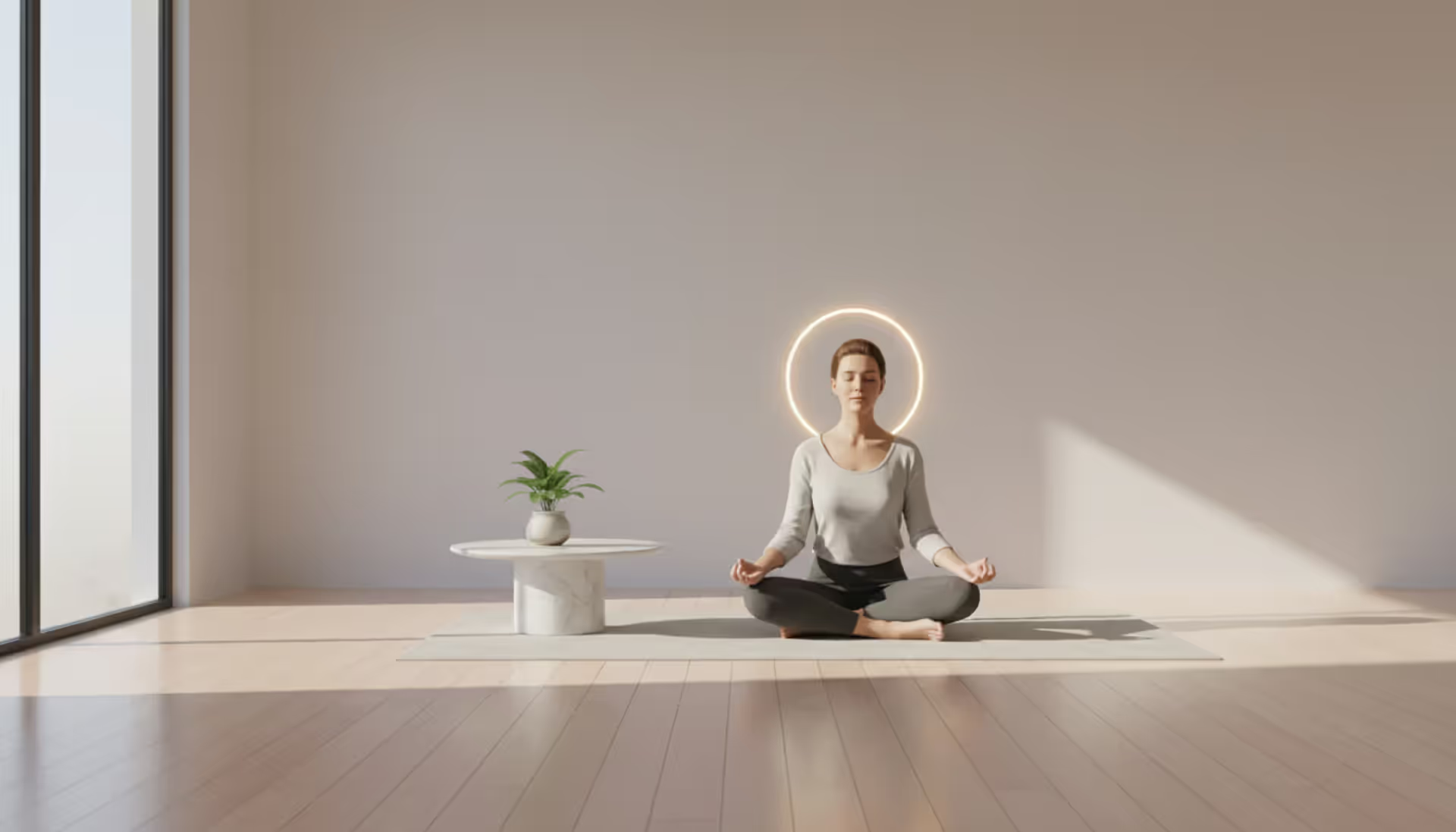
A person sitting cross-legged in meditation pose with eyes closed in a bright minimalist room with natural light streaming through a large window and a green plant nearby
Back in the late 1950s, Maharishi Mahesh Yogi brought a specific meditation technique from India to Western audiences. Since then, it's become something quite different from your typical meditation app or YouTube tutorial—it's a formal training program that's reached millions of people worldwide. Here's what you actually get when you sign up for a TM course, and why this particular approach requires sitting down with a certified instructor instead of just reading about it online.
What Is Transcendental Meditation?
TM comes straight from India's Vedic tradition, though Maharishi Mahesh Yogi was the one who packaged it for modern practitioners. At its core, you're working with a mantra—but not in the way most people think of mantras.
Your mantra isn't a meaningful word or phrase you choose because it resonates with you. It's actually a specific sound with no semantic meaning at all. You'll practice for twenty minutes, twice each day, silently repeating this sound in your mind.
Here's where TM diverges from other meditation styles you might've tried. You're not concentrating on your breath. You're not watching your thoughts float by like clouds. You're not trying to stay hyperaware of the present moment. The mantra acts more like a vehicle—it naturally draws your mind inward to progressively quieter mental states until you hit what TM practitioners call "transcendence." That's the point where thinking stops but you're still awake and aware.
Mindfulness meditation asks you to observe everything happening right now. Guided meditations walk you through visualizations or body scans. TM does neither. There's no effort to empty your mind, no forcing yourself into any particular state, no monitoring what you're thinking about.
Maharishi created a standardized teaching protocol to maintain quality control across thousands of instructors. This is precisely why you can't just pick up TM from a book—the nuances of the technique depend on personalized coaching and real-time feedback while you're learning.
How Does Transcendental Meditation Work?
The mechanics are straightforward. Find a comfortable seat, close your eyes, and begin silently repeating your assigned mantra. The sound itself carries no meaning—it was selected for its vibrational qualities rather than any conceptual significance.
As you continue with the mantra, your mind naturally drifts toward increasingly subtle, refined levels of mental activity. This isn't something you force. When you realize you've wandered off into regular thinking, you simply ease back to the mantra. No judgment, no frustration. Think of it like letting a feather drop rather than pushing it downward.
EEG studies have tracked what's happening in the brain during TM sessions. Researchers observe coherent alpha wave patterns spreading across different brain regions—a signature that distinguishes TM from both regular waking consciousness and sleep. Your heart rate drops. Breathing slows down. Oxygen consumption decreases. Your body's getting deep rest while your mind stays clear.
This pairing—physical relaxation combined with mental alertness—is what people mean when they talk about "transcending." The mantra gradually becomes fainter. Sometimes it disappears completely as you settle into pure awareness. You're not asleep or lost in thought, but conscious in a refreshingly different way.
Author: Lena Ashcroft;
Source: 5sensesspa.com
Each session runs exactly twenty minutes. Most people practice twice daily: once before breakfast, once before dinner. The timing matters more than you might expect. Meditating right after eating or too late at night interferes with how deeply you can settle.
What You Learn in a Transcendental Meditation Course
Official TM training follows a seven-step format that Maharishi developed decades ago. Certified instructors worldwide follow this same structure. The heart of your learning happens across four consecutive sessions, typically spread over four days.
The Four-Session Training Structure
Session one involves a personal instruction ceremony lasting roughly an hour. You'll receive your specific mantra and learn exactly how to use it. The instructor walks you through the proper mental approach—not through explanation alone, but by guiding you through your very first meditation. This initial experience becomes your reference point for all future practice.
Session two digs into the mechanics. Your instructor explains what actually occurred during meditation, why the technique functions this way, and addresses whatever you experienced during your first attempts at solo practice. You'll meditate again with supervision, which lets the teacher spot and correct subtle errors in how you're applying the technique.
Session three covers the bigger picture: higher states of consciousness that may develop with consistent practice over months and years. This connects your daily twenty-minute sessions to long-term developmental possibilities, mapping out the progression from basic stress relief to more enduring inner calm.
Session four focuses on practical integration. How do you maintain correct practice over time? What should you do when one meditation feels completely different from the previous one? How do you access support down the road? The instructor provides guidance for common experiences like restlessness, sleepiness, or intrusive thoughts during meditation.
After these four days, you're ready to fly solo. This training isn't about memorizing a procedure—it's about internalizing a particular mental approach that doesn't translate well to written instructions.
Author: Lena Ashcroft;
Source: 5sensesspa.com
Personalized Mantra Assignment
Your TM mantra comes from a limited set of sounds rooted in Vedic tradition. The instructor selects yours based on specific factors like your age and gender, following criteria that Maharishi established.
You don't pick your mantra based on what sounds nice or what it might mean. Its power comes from its sonic characteristics—the specific vibration it creates when you think it silently. Grabbing a random word or choosing your own phrase won't produce the same neurophysiological effects. The mantras used in TM were deliberately chosen for their capacity to facilitate transcendence.
This explains the confidentiality around TM mantras and why they're not published online. The practice depends on receiving an appropriate sound through proper instruction, not on the mantra itself having magical properties. The secrecy serves a practical function: it prevents people from attempting to use mantras without understanding the complete technique, which typically leads to incorrect practice and disappointing results.
Follow-Up Support and Lifetime Resources
Your course enrollment includes unlimited checking sessions at any TM center anywhere in the world. Forever. If your practice feels off six months in, if you're struggling to maintain consistency, or if you just want to meditate alongside other practitioners, you can schedule time with certified instructors without paying again.
Most centers run weekly group meditations and knowledge sessions where practitioners share experiences and explore deeper aspects of the practice. These gatherings create community and address questions that surface as your practice evolves.
After you've established a solid foundation, advanced courses become available. Weekend retreats, residential programs, and advanced techniques that build on your initial training—all optional, but they offer pathways to deepen your practice beyond the basics.
How to Start Transcendental Meditation
Starting TM means finding a certified instructor. The official TM website has a directory organized by location. Type in your zip code to find nearby centers, check upcoming course schedules, and register for an intro talk.
Most centers host free introductory sessions where instructors explain what the technique actually involves, field your questions, and walk through what the course entails. These run about an hour and don't obligate you to sign up. Even if you're on the fence, they're valuable for clarifying what TM is and what it isn't.
Course fees vary depending on where you live and your personal circumstances. In the US as of 2026, adults typically pay between $960 and $1,500. You can pay in installments or upfront depending on the center's policies. Students get reduced rates. So do couples, families, and anyone facing financial hardship. Some centers provide need-based scholarships or payment plans stretching across several months.
That fee covers your four-session training, all future follow-up support (permanently), and access to TM centers globally. Unlike meditation apps with recurring subscriptions, there's no monthly charge. One payment, lifetime access to instruction and community resources.
Before your first session, you'll need to stay away from recreational drugs for fifteen days and alcohol for twenty-four hours. Bring six fresh flowers, three pieces of sweet fruit, and a clean white handkerchief to the initial instruction. These items are used in a brief traditional ceremony—not religious, but honoring the lineage of teachers who preserved this technique across generations.
Wear comfortable clothes and set aside about ninety minutes for that first session. The following three sessions run shorter, usually around an hour each. Try to schedule them on consecutive days to maintain momentum while you're learning.
Author: Lena Ashcroft;
Source: 5sensesspa.com
Can You Learn Transcendental Meditation Without a Course?
You'll find plenty of books, articles, and videos about TM online. None of them can replace actual instruction. The technique involves mental subtleties that require personalized feedback to master properly. Reading about TM is like reading about swimming—you'll grasp the concepts, but you won't develop the embodied skill.
The biggest misconception? That TM is just silently repeating any word you want. While mantra repetition is central, the specific way you use that mantra determines everything. How much effort do you apply? What do you do when thoughts intrude? How do you handle the mantra's natural fading? Get these wrong and you're not practicing TM—you're just thinking a word repeatedly.
Self-teachers usually apply too much concentration, converting the practice into focused attention meditation rather than the effortless settling that characterizes actual TM. Others treat the mantra like a thought to observe rather than a vehicle for transcendence. These subtle errors prevent the deep rest and coherent brain functioning that research on properly taught TM consistently demonstrates.
Author: Lena Ashcroft;
Source: 5sensesspa.com
The TM organization insists that correct practice requires one-on-one instruction because everyone's nervous system responds differently. What feels effortless to you might feel like intense concentration to someone else. An instructor observes your practice, asks targeted questions about your experience, and makes corrections that no written guide can provide.
Some people attempt to reverse-engineer the technique from descriptions by former practitioners or leaked mantra lists online. Even with a legitimate mantra, without understanding the complete procedure and receiving feedback during those crucial early sessions, you'll likely develop a hybrid technique that differs from actual TM.
The course exists because Maharishi discovered that improper practice doesn't just fail to produce benefits—it can create mental strain. Investing in formal training ensures you learn correctly from day one rather than reinforcing mistakes that become harder to correct later.
Benefits of Transcendental Meditation
TM is a simple, natural technique that allows the mind to settle down to a state of deep rest while remaining fully alert. This unique state appears to have profound effects on reducing stress and anxiety while enhancing overall well-being
— Dr. Norman Rosenthal
More than 400 peer-reviewed studies have examined TM's effects on cardiovascular health, anxiety, PTSD, cognitive function, and overall well-being. The research shows measurable impacts across multiple health categories.
Cardiovascular improvements stand out prominently. Blood pressure decreases in hypertensive patients. A 2013 study in Circulation: Cardiovascular Quality and Outcomes found TM practice correlated with a 48% reduction in heart attack, stroke, and mortality rates among coronary heart disease patients compared to health education controls.
Stress and anxiety reduction appears consistently throughout the research literature. A 2014 meta-analysis in the Journal of Alternative and Complementary Medicine showed TM produced significantly greater anxiety reductions compared to other meditation and relaxation techniques. Veterans with PTSD have demonstrated symptom reduction across multiple studies, prompting TM programs in VA hospitals and military settings.
Cognitive benefits include sharper focus, enhanced creativity, and better academic performance. Students practicing TM show improvements in executive function and working memory. One study of employees at a biotech company found TM practitioners demonstrated increased brain integration linked to improved problem-solving and decision-making.
Sleep quality frequently improves as the deep rest during meditation compensates for accumulated stress and fatigue. Many practitioners fall asleep faster and wake feeling more refreshed, even with identical sleep duration.
The practice has attracted noteworthy practitioners across various fields. Oprah Winfrey introduced TM to her entire company staff and has discussed publicly how it's enhanced her creativity and decision-making. Filmmaker David Lynch established a nonprofit promoting TM in schools and with at-risk populations. Hedge fund manager Ray Dalio credits the practice as the single most important factor in his life and a major contributor to his success.
These benefits accumulate with regular practice. Most research examines practitioners who've meditated twice daily over months or years. Sporadic practice delivers less reliable outcomes.
Comparison of Meditation Techniques
Feature
Transcendental Meditation
Mindfulness Meditation
Guided Meditation
Vipassana
Core Approach
Silent mantra repetition, no effort
Observing present-moment experience
Following spoken instructions
Scanning body sensations systematically
Learning Requirements
Must complete certified course
Books, apps, and videos widely available
Simply play audio recordings
Ten-day silent retreat recommended
Daily Practice Duration
Two 20-minute sessions
Flexible; typically 10-45 minutes
Whatever the recording length is
1-2 hours after initial training
Uses a Mantra
Yes, assigned personally
No
Occasionally
No
Main Documented Effects
Lower blood pressure, reduced stress
Better emotional regulation, less anxiety
Improved relaxation, easier sleep
Mental clarity, profound insight
Financial Investment
$960-$1,500 one-time payment
No cost to $15 monthly for apps
No cost to $20 monthly
Donation-based
Frequently Asked Questions About TM Courses
How much does a transcendental meditation course cost?
You'll pay between $960 and $1,500 in the US as of 2026 if you're an adult. Students, seniors, couples, and families qualify for reduced pricing—often half off or more. Financial assistance programs and flexible payment plans help people who couldn't otherwise afford the full fee. That single payment covers your initial four-session training, unlimited follow-up support forever, and access to every TM center worldwide. No recurring subscription fees.
How long does it take to learn transcendental meditation?
The core training spans four consecutive sessions, usually completed over four days. Each session lasts 60-90 minutes. After those four days, you can practice on your own. That said, truly mastering the subtleties continues over the following weeks as your nervous system adapts and you gain experience with different states during meditation. Most people feel comfortable with the basic technique immediately, but understanding deepens through ongoing practice and optional follow-up sessions.
Do I need to be spiritual or religious to practice TM?
Not at all. TM doesn't require any belief system, lifestyle modifications, or philosophical commitments. The technique is a mental procedure with measurable physiological effects. Practitioners include people from every religious background plus plenty of atheists. While TM originated in Vedic tradition, the practice itself contains no worship, prayer, or religious content. The brief ceremony during initial instruction honors the teaching lineage but doesn't require you to participate in any religious activity.
What is a TM mantra and how is it chosen?
Think of your TM mantra as a meaningless sound—not a word carrying semantic content. It's selected from a specific set used within the tradition. Your instructor assigns it based on criteria including your age and gender, following standardized guidelines. The mantra works because of its vibrational characteristics and compatibility with your nervous system, not because of personal meaning or your preference. It stays confidential to protect the integrity of your practice and prevent incorrect self-teaching by others.
Can children learn transcendental meditation?
Kids as young as four can learn age-adapted versions of TM with shorter practice periods. The technique gets modified based on developmental stage: young children practice 10 minutes once or twice daily, while teenagers follow the adult protocol of 20 minutes twice daily. Hundreds of schools worldwide have woven TM into their daily programs, reporting improvements in academic performance, classroom behavior, and emotional resilience among student practitioners.
Is transcendental meditation the same as mindfulness?
TM and mindfulness operate through fundamentally different mechanisms. Mindfulness involves sustaining present-moment awareness of thoughts, sensations, and surroundings—an active attention practice. TM uses a mantra to let your mind settle inward effortlessly, transcending thought rather than observing it. Research reveals distinct brain patterns: mindfulness generates focused gamma waves, while TM produces coherent alpha waves associated with restful alertness. Both offer legitimate benefits, just through different pathways.
TM courses deliver structured training in a technique that doesn't translate to books or apps. The four-session structure, personalized mantra selection, and lifetime support system ensure you develop correct practice from the beginning. While the upfront cost exceeds free meditation resources, the standardized instruction solves the problems inherent in self-teaching and connects you to a worldwide community of practitioners and instructors.
Whether you pursue formal TM training depends on your wellness priorities, available budget, and interest in a practice backed by substantial research. The technique's simplicity—twenty minutes twice daily with zero required lifestyle changes—makes it sustainable for people who've struggled with more demanding meditation approaches. For those wanting a scientifically studied method with clear learning pathways and ongoing support, a TM course provides a structured entry point into a practice that millions have maintained for decades
Loving kindness meditation cultivates unconditional goodwill toward yourself and others through specific phrases and mental imagery. Originating from Buddhist metta practices, this technique systematically expands compassion from self to all beings, offering measurable mental and physical health benefits
Vedic meditation is a mantra-based practice from ancient India that uses silent sound vibrations to help the mind settle naturally. Practitioners sit comfortably for twenty minutes twice daily, silently repeating a personalized mantra. The technique requires no belief system or lifestyle changes
Discover how mindfulness walking meditation transforms ordinary steps into a powerful practice for calming the mind and grounding the body. This comprehensive guide covers techniques, benefits, different styles, and practical tips for beginners and experienced practitioners alike
Discover practical meditation techniques that interrupt anxiety's grip on your nervous system. From box breathing for immediate calm to body scan meditation for physical tension, learn evidence-based methods with step-by-step instructions that work when you need them most
The content on this website is provided for general informational and educational purposes only. It is intended to explain concepts related to meditation, mindfulness, mental health, and spiritual practices.
All information on this website, including articles, guides, and examples, is presented for general educational purposes. Meditation outcomes may vary depending on individual practices, health conditions, and guidance.
This website does not provide medical, mental health, or spiritual advice, and the information presented should not be used as a substitute for consultation with qualified professionals.
The website and its authors are not responsible for any errors or omissions, or for any outcomes resulting from decisions made based on the information provided on this website.